Mostrar mensagens com a etiqueta Arduino Models. Mostrar todas as mensagens

terça-feira, 20 de maio de 2014

Arduino Shield List

Arduino Shield List

Pin usage details for 317 shields from 125 makers, and counting!


segunda-feira, 19 de maio de 2014

Arduíno Mega e os novos arduíno ARM. Qual o melhor investimento?

Estava a pensar comprar um arduino uno e um arduino mega, Entretanto soube de novo hardware da arduíno (com arquitetura ARM) que vai sair e fiquei indeciso, dado que parece ter mais capacidades de memória e rapidez. O que vos parece? Sei que o UNO tem muitos utilizadores e muitos projetos, talvez não seja mau para um principiante. Será um desperdício comprar o mega?


Os Atmel de todas as Arduinos são processadores ARM.
Os diversos modelos diferenciam-se pela memória e velocidade, pelo nº de portas e alguma especificidade que evitará aquisição de shields e outros modulos.

O Arduino Mega permitirá projectos mais complexos quer ao nivel do hardware quer do software.

Penso que é de começar com um Uno e depois face às necessidades, evoluir para Mega ou Duo.

Opinião sobre aquisições de material

Sobre aquisições de equipamentos.


  • A diferença de preços entre as compras nacionais e através do eBay são relevantes.
  • Cuidado com o valor das compras de forma a não ser necessário pagar taxas alfandegárias.
    A inclusão de placas Arduino nos kits, faz com que o seu valor fique perigosamente alto.
  • Sou da opinião que se deve comprar por cá as placas Arduino, beneficiar da garantia de 2 anos e da proximidade da loja.
  • Já no que se refere aos restantes materiais, julgo ser vantajoso comprar online. Uma pesquisa evidencia bem as diferenças para a carteira de cada um.
  • Recordo que antigos computadores, impressoras, drives de CD e DVD são excelentes fontes de componentes electrónicos, nomeadamente motores, dispositivos de infravermelhos, cabos condutores, leds, etc.
  • Uma visita a um sucateiro pode ser bem proveitosa no que respeita a potenciómetros, motores cc e a-passo, relés e alguns artefactos mecânicos.

Starter Kits made in CHINA


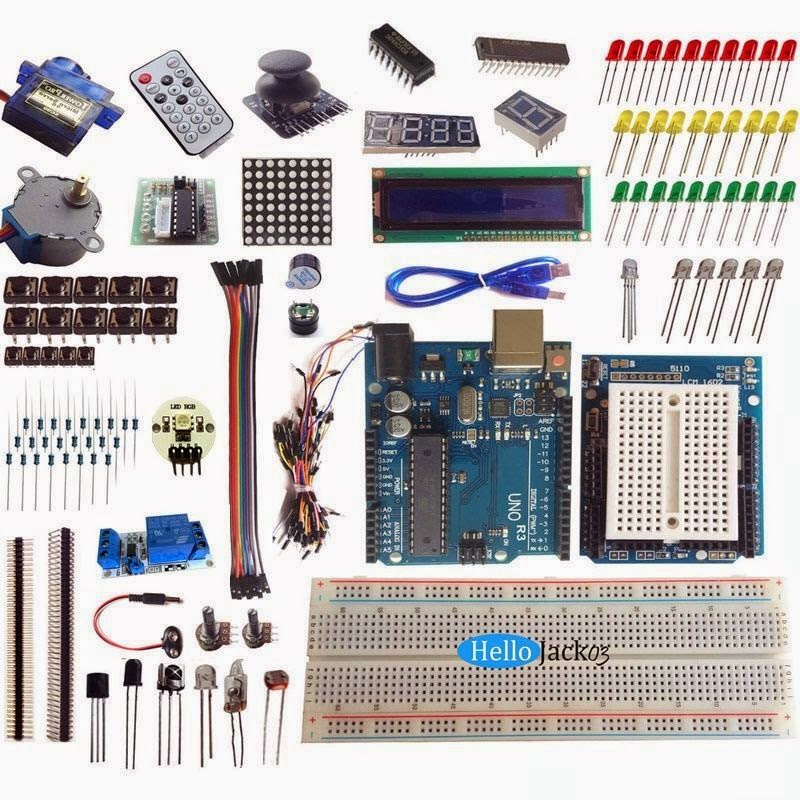
UNO R3 Starter Kit 1602 LCD Servo Dot Matrix
Breadboard LED Resistor for Arduino
Aprox. EUR 41.00
                                                    

SunFounder Project LCD Starter Kit For
Arduino UNO R3 Mega2560 Mega328 Nano

Aprox. EUR 16.00
                                                    

UNO R3 Starter Kit LCD1602 Servo 

Motor Breadboard For Arduino Technical Support

Aprox. EUR 41.00
                                                    

Starter Kit RFID Master With Motor Relay LCD 

Servo AVR for Arduino 1602 UNO R3

Aprox. EUR 44.00
Ir para a página
                                                    

UNO R3 Upgrade Kit with Motor LCD
Servo Module for Arduino AVR Starter
Aprox. EUR 35.00
                                                    
New Ultimate UNO R3 Starter Kit for Arduino 

1602 LCD Servo Motor LED Relay RTC.

Aprox. EUR 41.00
                                                    

KITS Arduino a considerar

UNO Rev3 New Version Starter Package Kits -Arduino Compatible

                                                       Aprox. 60€


Robot DIY Starter Beginner Kits Relay Stepper Infrared 1602 LCD For Arduino


                                                                  Aprox. 60€


SainSmart UNO R3 + LCD1602 Starter Kit For Arduino Compatible DIY Mega2560 Robot


                                                        Aprox. 32€


New Version Mega2560 Starter Package Kits -Arduino Compatible


                                                        Aprox. 66€


Arduino robot kit wireless control 2wheel


                                                          Aprox. 60€
Ir para a página

Parecem-me compras interessantes para inicio de projectos de robótica.

No eBay (todos com portes gratuitos ou incluidos e compra directa, não sujeitos a leilão/ofertas)

Atenção, compras de valor igual ou superior a 40€ sujeitas a taxas alfandegárias.
                                                                                                                                                                 
Aprox10.00 €
Nota: Kit Básico de preço acessivel, há bastantes variantes                                                 
Aprox 46.00 €
 Nota: Boa relação preço e funcionalidade                                                 
Aprox 40.00 €
                                                  
Aprox 37.00 €

                                                  
Aprox 20.00 €

                             Nota: Bom para sistema de vigilância                    

Aprox 126.00 €

                                         Nota: Carote mas muito interessante, problema com taxas alfandegárias         

Lojas de Arduino/Robótica em Portugal


 Loja

Lojas de Robótica em Portugal (Fonte Lusorobotica)

Robótica em Portugal tem se desenvolvido bastante, contudo nem sempre é fácil encontrar os produtos que pretendemos e como tal, nada melhor do que ter uma lista organizada das lojas portuguesas de robótica

Com o objectivo de facilitar a compra de componentes de robótica em Portugal, resolvemos fazer uma lista das lojas portuguesas de robótica facilitando tanto quem compra como quem vende.


sábado, 17 de maio de 2014

Arduino DUE - an official Arduino with ARM

Arduino DUE - an official Arduino with ARM

Arduino » Arduino Due

wired.com
Arduino obviously helps achieving lots of tasks with minimal knowledge, and hardware needs. Its all there – IDE, compiler, programmer and board. Tons of libraries and shields makes this thing hold strong positions among other platforms. Anyway there are lots of claims that AVR based Arduino many times reaches its limits when speaking of performance, memory and features. When Arduino DUE appeared things is gonna change – at least in some areas. Still same useless IDE and most of libraries but it’s gonna beat this with much higher performance and RAM.
The long-awaited Arduino Due just hit the market, replacing the 8-bit, 16MHz brain of the popular Uno microcontroller prototyping platform with a 32-bit, 84MHz processor, while augmenting inputs and capabilities all around (Figure 1).
The Arduino Due and its Atmel SAM3X8E means your DIY 3-D printer can produce finer resolution, along with other improvements
Figure 1.The Arduino Due and its Atmel SAM3X8E means your DIY 3-D printer can produce finer resolution, along with other improvements.
For robotics and electronics hobbyists, its a moment of much excitement. But for the rest of us, what does this new controller offer over the older models?
“Having a 32bit ARM processor running at 84 MHz allows you to do much more much quicker,” explains Arduino co-founder Massimo Banzi in an e-mail to Wired. “If you think about the Quadcopters that Chris Anderson and his community are building (Figure 2), they need to read many sensors as fast as possible then process all that data to calculate how to keep the quadcopter flying properly. Having a faster processor, with much more capabilities like DMA can increase the stability, responsiveness and precision of the aircraft while using less chips to do it.”
Arduino Due controls this quadcopter
Figure 2.Arduino Due controls this quadcopter.
The heart of the Arduino Due is the Atmel SAM3X8E, an ARM Cortex-M3-based processor. And the board builds off the capabilities of this summer’s Arduino Leonardo release, offering two micro USB ports – one for programming and communications and one that allows the Due to act as a client or host, allowing it to act as or utilize a USB mouse or keyboard. This addition gives Banzi excitement. “The USB host is something people have requested a lot over the years and it’s one of the places where we’re going to see the craziest applications being developed by the community.”
Thanks to its new Atmel chip, the Arduino Due takes a giant leap forward in terms of ADC performance, allowing designers to push the limits of their creations. “Many people have built cool open source scientific instruments using Arduino in the past, with the Due they get 12-bit analog inputs, 12-bit analog outputs,” Massimo explains. The theoretical sampling rate has been multiplied to a whopping 1,000 ksps (kilosamples per second). In comparison, the Arduino Uno, Leonardo, and Mega 2560 boards all have theoretical ADC speeds of 15 ksps.
The Due is also the first Arduino to feature a built-in digital-to-analog converter – two, in fact. An audio library for the Due is also being released, coupling onto the Due’s ability for wav file playback. Meanwhile, rumors about a Google-written ogg player code that can also be used.
The Arduino team also worked with Google’s Android Developer Kit team on the ADK 2012 platform, who used a version of the Due’s layout for their board. But despite the general popularity Android, Banzi sees room for much growth in the ADK community.
“Unfortunately we have seen very few applications done by the community.” he says. “I think Google should promote it more and work with the community to make the right tutorials, the right documentation that would make people embrace it. If you think about it, Apple has a similar technology that is proprietary, closed source, covered by NDA and requires a special chip and yet you see many hardware accessories developed for the iPhone/iPad. Android has a good technology released as open source and yet it gets less traction.”
Meanwhile, the Due continues to support the ADK 2.0 protocol, making it compatible with Google’s libraries and certain code written for the ADK.
The Due will continue to work with all Arduino shields – add-on boards and circuitry like motion sensors and LED light arrays – that conform to the official Arduino Revision 3 layout. However, the Due operates at 3.3V whereas AVR-based Arduinos operate at 5V, meaning some third-party shields that don’t follow the R3 specs to the letter may not be compatible, depending on their voltages. It also means those looking to use the Due in existing applications should adjust their voltage or risk damaging their board.
The Arduino team has also assured that changes to the IDE will allow for cross-platform compatibility. Sketches that you write for your Uno or other AVR-based boards can run on a Due. There will of course be under-the-hood differences in how the software compiles your programs, but the design is intended to make the user experience seamless.
Despite its increase in power and features, beginners and less advanced users will probably want to stick with the classic Uno for now. “The basic Arduinos like the UNO or Leonardo are still the best to learn with.” says Banzi “They are super simple, very stable and come with tons of examples and libraries.”
As for the delay in the release of the Due, Banzi credits it to growing pains. “In the last two years, we had to move from a loose group of people working on the project to a proper company with properemployees to take care of all of the different business functions,” He explains. “Now there are doors around the world with Arduino (or Officine Arduino) written on it, with teams doing good work. Growing up sometimes slows things down.”
The Due was introduced in October 2012, and is priced at $49.
Technical Specification
  • Microcontroller: AT91SAM3X8E
  • Operating Voltage: 3.3V
  • Input Voltage (recommended): 7-12V
  • Input Voltage (min/max): 6-20V
  • Digital I/O Pins: 54 (of which 6 provide PWM)
  • Analog Input Pins: 12
  • Analog Output Pins: 2 (DAC)
  • Total DC Output Current on all I/O lines: 130 mA
  • DC Current for 3.3V Pin: 800 mA
  • DC Current for 5V Pin: theoretical 1A, recommended 800 mA
  • Flash Memory: 512 KB
  • SRAM: 96 KB (64 + 32 KB)
  • Clock speed: 84 MHz
  • Debug access: JTAG/SWD connector

quinta-feira, 15 de maio de 2014

Arduino Zero

Hinted at yesterday by Massimo Banzi during his keynote speech at MakerCon yesterday, Arduino has just officially announced their latest board—the Arduino Zero.

On the surface the board may look very similar to the Arduino Leonardo, but there are big differences. Powered by a 32-bit ARM Cortex M0+ core, the Atmel SAMD21, the new board is significantly faster than the traditional 8-bit Arduino boards, running at 48MHz, and is much more capable.

While it shares the same form factor as the Arduino Leonardo—with 14 digital and 5 analog pins—all of the digital pins except the Rx/Tx pins can act as PWM pins, and the analog pins have a 12-bit ADC instead of the Leonardo’s 10-bit ADC, giving significantly better analog resolution.

maker-faire-bay-area-logo-2014The new board comes with 256KB of Flash memory, and 32KB of SRAM. In comparison the 8-bit Leonardo which uses the Atmel ATmega32u4 comes with just 32KB of Flash memory and 2.5KB of SRAM. While the new board doesn’t have EEPROM, it does support 16KB by emulation, so Arduino sketches relying on this feature will still run without issue.

Like the Arduino Due, the first Arduino micro-controller to be based on an ARM core, the new Zero runs at 3.3V while there is a 5V power pin on the board in the usual place, it looks like the voltage of the rest of the digital and analog pins is 3.3V rather than the normal 5V—so any shields you use with the board will have to be 3.3V compatible.

One of the interesting differences about board layout of the Zero is the addition of an extra micro-USB port. While information is pretty thin on the ground at the moment, the SAMD21 supports both USB Host and Device mode, so it’s possible that that extra port is to support that functionality. Although its also possible that this USB port could be dedicated to support Atmel’s Embedded Debugger (EDBG) as this is the first Arduino board to support this feature. EDBG is an interesting addition—it provides as it provides a full debug interface without the need for additional hardware.

The first prototypes of the new board will be on display at the Arduino (#204), Atmel (#205) and ARM (#405) booths at Maker Faire Bay Area, which kicks off in just two days time. So see you at the faire, the greatest show (and tell) on Earth!

Arduino Yún

Announced earlier in the year at Maker Faire Bay Area, the Arduino Yún is the first Linux-based Arduino board putting it in a unique position—at least for now—in the Arduino hardware lineup. It combines a Atmega32U4-based “classic” Arduino, similar to the Ardunio Leonardo, embedded directly on the same board as a Wi-Fi system-on-a-chip running Linino—a MIPS Linux distribution based around OpenWRT.


Arduino Tre

The new Arduino Tre board. Near-side of board: USB (left), HDMI (middle) and Audio In/Out (right). Far-side of the board: 5V power jack (left), micro-USB (lift-middle), Ethernet (right-middle) and USB (right). In the middle we have GPIO headers for the ARM processor, along with Arduino form-factor headers for the AVR processor. Right in the middle are headers to insert an XBee radio.

terça-feira, 13 de maio de 2014